Wednesday, November 25, 2020

International Day of the Girl Child (IDGC) 2020 Celebrations


To commemorate this year’s International Day of the Girl Child, which had the theme “My voice, our equal future”, Society for the Improvement of Rural People (SIRP) organized two great and inspiring activities. The first activity was a campaign to end period poverty in Akwuke community of Enugu State, Nigeria. In this regard, we targeted 16 young girls from the community who we taught about menstrual hygiene generally. We furthermore stressed the need for them to avoid using various unhygienic materials during their periods. Finally, we provided them with sanitary pads and various toiletries.

On the other hand, we implemented a skill acquisition program at Okpanku community of Enugu State, Nigeria. In this regard, we targeted 15 young women and girls. We empowered them by training them on how to bake various snacks like buns, fish rolls, fish pies and small chops. This training is in clear alignment with our definition of Women Economic Empowerment (WEE). We define WEE as the process by which women and girls gain the ability to make decisions not just for themselves, but also for others.

All in all, we sure had fun and were also fulfilled implementing these activities as we made a tremendous impact in the lives of our beneficiaries. The goal for us still remains the attainment of the Sustainable Development Goal (SDG) 5, which provides for gender equality and women empowerment by 2030.


SIRP last week in Bridge-waters hotel, Enugu organized a workshop on gender responsive budgeting for 10 participants. These 10 participants comprised of both Civil Society Organizations (CSOs) and relevant Government officials. The whole basis for this workshop was to build their capacity on tracking the Enugu State Government budget as it relates to child marriage.

This program kicked off with an opening prayer and introductions facilitated by Miss Nnedi. After this, there was a brief opening remark from Dr. Chris Ugwu, the Executive Director of SIRP, Nigeria. He first of all thanked GirlsNotBrides (GNB) for supporting this program. Thereafter, he thanked all the participants for making out time to attend this training. After the opening remark, Evelyn Onah from Tarma Sarc disagreed to Tarma Sarc being addressed as a ministry. She said that 'Tarma Sarc was handed to the Enugu state government in 2017 and is being handled by the Ministry of Gender Affairs, Health and Justice.

We thereafter went on an assessment of the current status of the implementation of the Enugu State 2020 budget in light of the COVID-19 pandemic in the State. This is most especially with regards to child marriage and adolescent girls. We thereafter went on to train participants on how to use PETS (Public Expenditure Tracking Survey) framework in budget and expenditure tracking.

After this training, we thereafter entertained comments from a host of participants. First to speak was Anna Oguejiofor from the State Ministry of Health (SMOH). She said that they were not contacted on time prior to the workshop hence, can't present documented figures, but will use estimated figures. She went further to suggest that budgets should be critically studied, and that the limitations caused by the COVID-19 pandemic shouldn't be ignored. She also suggested for the Enugu State Universal Basic Education Board (ENSUBEB) to be invited for meetings/workshops like this. Rhoda Ikechukwu from ACERDEN on her own part suggested that new strategies should be explored in regards to children completing their education. This is most especially with menstrual products. She went further to complain about how schools write to organizations like ENSUBEB for support without getting any response. Virginia Obianugo from CIRDDO said that she's aware that menstrual materials were released in this COVID-19 period. She however said that her issue of concern is ministries not meeting up to what they signed as budgets. She mentioned a case whereby 40 seats were released to a school instead of 100 as budgeted and signed.

After this series of comments, the participants were later split into 3 groups under gender, health and education, for them to properly discuss the gender mainstreaming in these budget lines. After these deliberations, they thereafter make group presentations.

Finally, the workshop came to an end with a closing remark by Dr. Chris Ugwu thanking everyone for coming and specially thanking GirlsNotBrides (GNB) for supporting this program.

Thursday, November 19, 2020


The second edition of “2063 Academy”


With the support of the Swiss Embassy Rabat and in partnership with the Moroccan Ministry

in charge of relations between parliament and civil society, World Bank Group as well as the

UN Information Center in Rabat, the moroccan NGO Atlas for Development launched the

“Academy 2063” project last year, which is a program that aims to increase awareness of Africa’s development agenda and its values, and make youth the center of africa’s sustainable development debate, throughout a series of discussions and workshops, as well as creating a common ground for youth and decision makers by inviting government personnel, diplomatic corps and international and national NGOs (civil society).

Following the success of the first edition of the 2063 academy, the second edition has chosen “The African Youth we want” as its theme, and will be open to young people from all over the continent. It will include virtual workshops aiming at polishing the participant’s skills in: public policy analysis, project management and entrepreneurship, on top of familiarizing African youth with The African Union by organizing workshops centered around the organisation’s work, and simulating it using a Model African Union sequence. This edition falls under the African Union “Silencing the guns” campaign, as it will focus on Climate Change and Gender Equality as the centers of the debate, strengthened by the presence of international experts and officials.

Coinciding with the Africa Youth Month, the 2nd edition of The 2063 Academy will be organized during November 2020 in partnership with African Union Special Envoy on Youth Bureau’s and with the support of PEACE FIRST organization, French and Swiss Embassies

in Morocco.


 AU and UN hailed the 2063 Academy


The first edition has/had garnered the attention of African Union commission, through African

Union Special Envoy on Youth, Ms. Aya Chebbi who have paid a special visit to Rabat to familiarize herself with the initiative that brought international and nation experts as well as representatives from different organisations to train 88 youngsters, who formed in turn 255

young people in the Rabat-Salé-Kenitra region.

The african youth envoy representative Ms.Aya Chebbi, called during her visit for Morocco to become a platform able to mobilize north african youth to participate in the African union’s programs, and for the initiative to be broadened/expanded at them regional level (North Africa) and even across the continent eventually. Ms. Chebbi’s visit, accompanied by a member of her consultations bureau Mr.Nair Abakar, also led to many meetings with diplomatic corps actors and NGOs and governmental organisations, in coordination with The international center for diplomacy and Atlas for Development.

Upon return to Addis Ababa, Ms.Aya Chebbi emphasized in a speech to the African Peace and Security Council the important role the youth plays in promoting peace in the continent, and added examples of projects lead by youth from multiple african countries, among them the moroccan initiative “The 2063 Academy” that aims at creating a common ground between young people and decision makers to increase awareness and work on the african 2063 agenda. The success of the first edition didn’t stop here, as the initiative was highlighted in many important international platforms, of which: the 2019 UN’s general assembly, where “The 2063 Academy” was chosen amongst the best international initiatives. It was also presented at the SDG MEDIA ZONE by Atlas for Development's president Mr. Hatim Elothmani.

The 2063 Academy also intrigued the 2017 peace nobel prize winner, Peace boat NGO, which has consultative status at the UN. As it organized with Atlas for Development, a number of events centered on Climate Change and the Sustainable Development Goals, these events knew the participation of UN officials, Accredited Diplomatic Missions as well as The World Bank.


For more information, do:

- Visit Atlas For Development website: www.atlas4dev.org

- Contact us by email at: contact@atlas4dev.org


Tuesday, November 5, 2019


The passage of the Violence Against Persons Prohibition Law (VAPP Law) in Enugu State, Nigeria

Enugu State lawmakers in April 2019 passed into Law the Bill seeking to eliminate violence against persons here in Enugu State. The Bill, which was a private member bill, meant to eliminate all forms of violence against persons in both public and private lives, was sponsored by Hon. Chukwuka Eneh representing Udi South Enugu State, Nigeria. This Bill effectively criminalizes various acts of violence like child marriage, female Genital Mutilation (FGM), rape, unfair widowhood practices, wife battery etc here in Enugu.

What not too many people know was that they were various organizations here in Enugu State, Nigeria who played various leading roles to ensure that this Bill was passed into law. It was indeed appalling and disheartening to see that after this Bill was passed that no major radio, television station and print houses made allusion to this great contribution. This is indeed sad because I for one know that if not for these organizations, the passage of this Bill would have been greatly jeopardized here in Enugu.

As the chairman of the Legislative Advocacy Coalition (LAC), which was a coalition of organizations here in Enugu that advocated for this passage. I will not fail to mention that organizations such as Women aid collective (WACOL), Society for the Improvement of Rural People (SIRP), Tamar SARC etc played a great role in this regard. They all worked together and came under one umbrella called the Legislative Advocacy Coalition (LAC).

They did not just dedicate their time, but also their resources in ensuring that this Bill was passed. As the chairman of this great coalition, I therefore wish to commend everyone and not just the foregoing who played one role or the other in ensuring that this Bill was passed. You all are the real heroes!

Written by:
Mr Chukwudi Ojiedo (Chairman LAC)


Tuesday, August 6, 2019


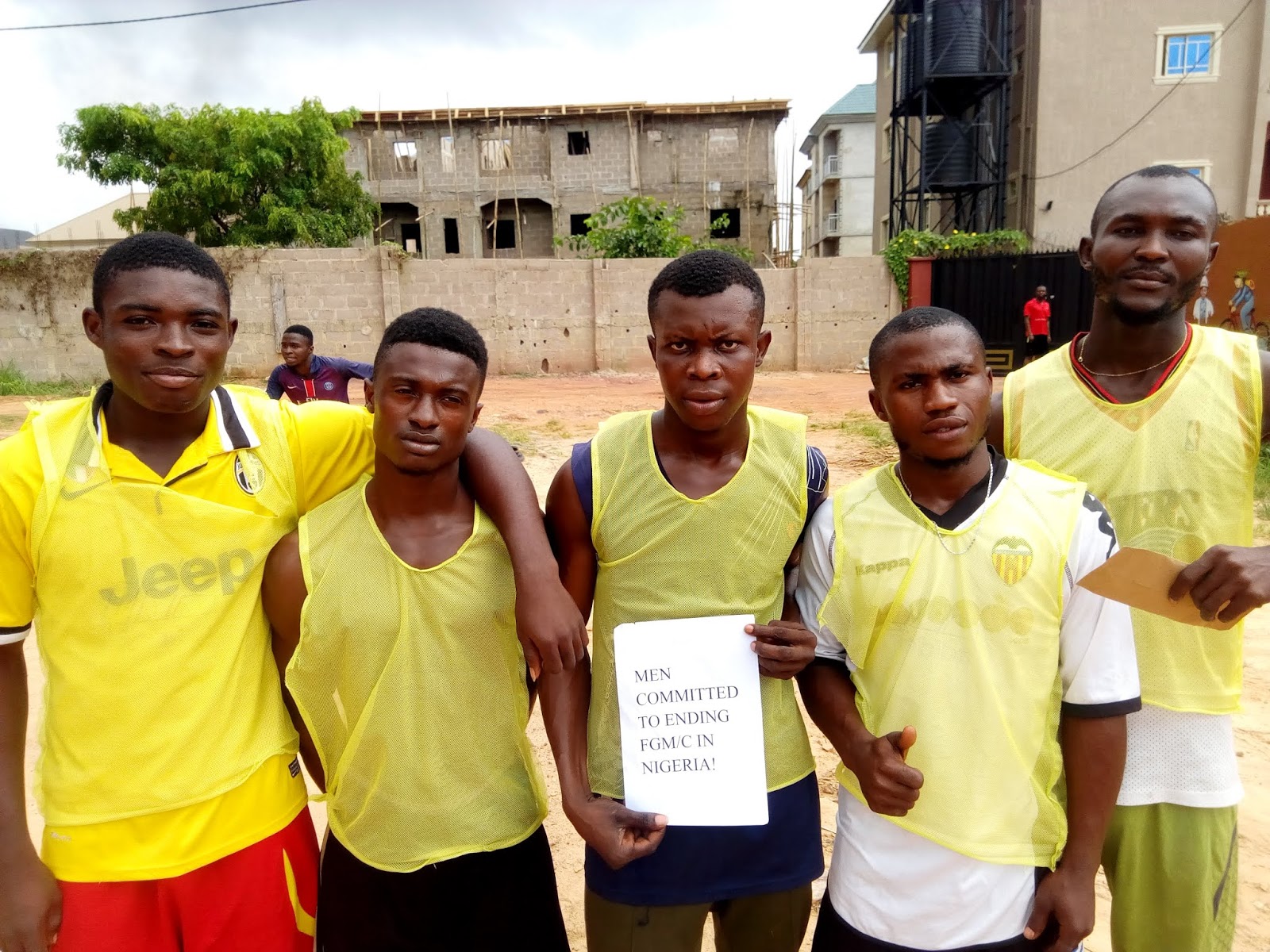
                             Using Soccer to help change norms around Female Genital Mutilation / Cutting (FGM/C)
Female Genital Mutilation/Cutting is a practice, which is deeply rooted in not just patriarchy and traditions here in Nigeria, but in also various misconceptions. One of such misconceptions here in Nigeria is that FGM/C curbs the girl child promiscuity. According to 28TOOMANY (UK), 20 million women and girls currently have been either mutilated/cut here in Nigeria. It is also projected that if nothing is done that by 2030, an additionally 20 million women and girls will undergo FGM/C in Nigeria. FGM/C is a social norm in Nigeria in the sense that many families engage in it simply because others are doing it. It is a practice, which communities have come to accept as their culture and as their way of life.
Late last year in Nigeria, Society for the Improvement of Rural People (SIRP) an organization committed to ending FGM/C here in Nigeria carried out a project called “Kick out FGM/C”. This project was aimed at using soccer as a tool to change norms around FGM/C in Nigeria. This project was implemented in Akwuke community of Enugu State, Nigeria. Before SIRP embarked on this project, they noticed that first and foremost most interventions around FGM/C in Nigeria has always involved the older generation more than the younger generation. Also, that most interventions have always involved the use of various traditional methods i.e. training workshops, dialogue sessions, sensitization programs etc. Little or nothing was done with regards to using various youth friendly approaches like soccer to ending FGM/C here in Nigeria. SIRP therefore decided to implement this foregoing project for one major reason and that is:
·         To increase the involvement of youth in ending FGM/C in Nigeria:
Since the world has a target to end FGM/C by 2030, there is greater need to more than ever involve more youth in this our shared vision. This is because youth are the ones to end FGM/C by 2030. Sadly enough, most interventions around FGM/C have always been boring, uninteresting and repetitive for most youth in Nigeria. Hence their reluctance to engage in various end FGM/C campaigns here in Nigeria.
To further buttress this point, SIRP conducted a research in Akwuke. The purpose of this study was to determine the level of awareness and involvement amongst youth in Akwuke to issues relating to FGM/C. In this particular study, SIRP adopted a descriptive research design. Specifically 2 research questions were posed to guide the study. A multi-staged sampling procedure using simple random sampling technique of balloting without replacement was used. We selected a sample of 210 youth accessing the only market in the community.
The instrument for data collection was our self-developed questionnaires. The data collected were analyzed using figures and percentages to answer the research questions. Below are some of the questions we asked them and some of the answers we got from them;
·         Question 1: Have you ever heard of FGM/C?
Yes
%
No
%
10
4.76
200
95.2
·         After we explained the meaning of FGM/C to them we then asked them;
·         Question 2: Would you love to see FGM/C ended in your community?
Yes
%
No
%
190
90.47
20
9.52

·         From the foregoing, one can see that only 10 youth out of the 210 youth, we gave out these questionnaires to have heard about FGM/C. Also 190 youth out of the 210 youth, we gave out these questionnaires wanted FGM/C to be ended in their community.

After the foregoing research, SIRP decided to adopt a youth friendly approach that will be both engaging and interesting for these youth and that approach was soccer. SIRP organized a 5 a- side soccer tournament for 6 youth teams from the community. At the end of the tournament, the youth team from Atako community of Akwuke won the tournament and therefore became our end FGM/C champions at the community.
At the end of the tournament, the following results were achieved:
·         There was an increase in the level of awareness amongst youth from the baseline of 15% to 45% at the end of the project.
·         There was an increase in the rate of involvement amongst youth in end FGM/C issues at the community from the baseline of 10% to 50%.
·         A reduction in the FGM/C rate at the community from the baseline of 65% to 45% at the end of the project.
The foregoing figures were derived from the series of interview sessions; we had with various youth from the community at the end of the project. One major lesson learnt from this project was that there is a huge number of youth who genuinely want to be involved in this ongoing activism to end FGM/C by 2030, but are not currently doing so much in this regard. This is largely due to the fact that most NGOs, anti-FGM activists, the Government in Nigeria etc has either failed to see youth as key allies in this our shared vision to end FGM/C by 2030. We therefore call for the use of various youth friendly approaches, which will be both engaging and interesting for youth in ensuring the involvement of youth in various end FGM/C activities.

Monday, July 15, 2019


What we are currently doing to promote the economic empowerment of young women and girls subjected to Female Genital Mutilation/Cutting (FGM/C) in Nigeria

The United Nations, at its General Assembly in November 2014, declared 15th July of every year as World Youth Skills Day. To commemorate this day, Society for the Improvement of Rural People (SIRP) and a Youth Economic Empowerment (YEE) platform called Unskilled to Skilled (U2S) will like to talk about what we are currently doing in this area here in Nigeria. This is especially with regards to promoting the economic empowerment of various young women and girls subjected to FGM/C in Nigeria.

Currently in Nigeria, 20 million women and girls are projected to have undergone one form of FGM/C or the other. This has led to not just a great health crisis here in Nigeria, but also a great economic problem for various FGM/C survivours in Nigeria. One might ask how FGM/C affects young women and girls economically. But the answer to this foregoing question is not far-fetched. When young women and girls are mutilated/cut they are married off immediately to various older suitors. This is done because FGM/C serves as a precursor to the girl child early marriage here in Nigeria. After she is married off, she invariably quits school so as to tend for her family. When she quits school, this automatically affects her chances of being gainfully employed in the future. This is one major way in which FGM/C affects young women and girls economically.

In tackling this problem, SIRP recently in conjunction with U2S adopted an innovative approach, which involves not just organizing various skill acquisition trainings for young FGM/C survivours, but also pairing them up with already established businesses here in Nigeria. We define YEE as the process by which youth gain the ability not just to make decisions for themselves, but also for others around them. We strongly believe that the end-result of every YEE program should be the financial independence of every youth.

With the foregoing definition in mind, we are currently working assiduously to ensure that various young women and girls that have been subjected to FGM/C are not just skilled, but are also financially independent here in Nigeria. So far we have used this innovative approach in more than 5 communities here in Nigeria. The result of this has been indeed huge and heart-warming. It definitely feels so great to see the huge impact that this approach is having on various FGM/C survivours here in Nigeria. We are also on course to scale up this approach to reach more communities here in Nigeria. We are not just committed to ending FGM/C in Nigeria, but are also passionate about the economic empowerment of various FGM/C survivours in Nigeria.

Happy World Youth Skills Day to you all!

Monday, June 17, 2019


UTILIZING A U2S MODEL TO PROMOTING WEE AT AKWUKE COMMUNITY OF ENUGU STATE, NIGERIA
Women Economic Empowerment (WEE) is defined as the process by which women gain the ability to make decisions not just for themselves, but also for others around them. We strongly believe that the end result of any WEE should be the financial independence of every woman.  Any WEE program that does not lead to a woman’s financial independence does not cut it for us.
With the foregoing in mind, last week Unskilled to Skilled (U2S) model for economic empowerment was utilized by two Non-Governmental Organizations based here in Nigeria and they include: the Society for the Improvement of Rural People (SIRP) and Growing the Girl Child Initiative (GTGCI). U2S is a Youth Economic Empowerment (YEE) which caters for every unskilled and unemployed youth (ages 18-30) here in Nigeria.
U2S exists to reduce the rate of youth unemployment here in Nigeria, which currently stands at 23.1% and this according to the Nigerian Bureau of Statistic (NBS) translates to 16 million youth here in Nigeria. U2S doesn’t just seek to train various youth on various vocational skills, but also to pair them up with already established businesses here in Nigeria at the end of their training. This indeed marks a clear departure from other economic empowerment programs and models here in Nigeria. This is because U2S leads to every youth financial independence.
From the foregoing therefore, we were highly excited and elated when last week we in collaboration with SIRP and GTGCI organized various skill acquisition programs for various young women at Akwuke community of Enugu State, Nigeria. We trained them on how to make liquid soap, insecticides, buns, cakes, peanuts and puff-puff. The trained participants are already being paired up at the moment with various businesses here in Enugu State. This pairing will help them in growing both in skill and also in their earning power. Indeed this program was a huge success.
Our gratitude goes to SIRP and GTGCI who believed in us. Together we will definitely achieve WEE here in Nigeria.